Argonauts and 40 Niners had its origins on Blogger, before I happened upon Webs.Com and signed up for that service. It has been almost one year since I started Argonauts and 40 Niners. After weighing the option of renewing my account with Webs.Com, I have chosen instead to return to Blogger. To say that Webs.Com has been disappointing would be an understatement, they've come up short in many aspects...lack of traffic, poor customer service, limited formatting features.. just to name a few. I thank the readers who stumbled upon my blog and signed up as members or left comments. I hope you follow me over to Blogger, I will continue to document the history of abandoned mines and other places of interest in Luna County, New Mexico, U.S.A. It's a part of the American West with a long legacy of historic events and sites. I'm in the process of copying and transferring my articles and pictures from Web.Com to Blogger. Luna Explorer is the new name of my blog and it should be up and running on Blogger by the end of March. I'm currently preparing a feature story about New Mexico's Descansos, the roadside memorials found alongside the state's roads and highways. In addition to the other projects I have in the works; Fluorite Ridge, Old Hadley, Cooke's Canyon (Ft. Cumming, Massacre Peak, Starvation Draw) The Cook Mining District (Cooks Town) and of course my never ending efforts to document the many mines in The Florida Mountain Mining District. Thank You all for your support. Ernest D. Aguirre
A Guide for Day Hikers and History Buffs
Sunday, March 6, 2011
Lobo Draw-Atir Mine Redux
I returned the following Sunday, with a goal of 1. finding my phone and 2. finding the Atir mine. As I drove into the Floridas I was greeted by a chorus of rifle fire from scattered hunters, most seemingly too close to the road for comfort. As I drove away from this haphazard gathering of outdoors men, I had to ask, why after taking the first shot and missing, would you immediately follow with 7-8 more shots in rapid succession? Any game that was in the vicinity, was making tracks, for safety's sake, as did I. Driving towards Lobo Draw with gunfire echoing off the hills, I had to fight the urge to cringe or duck down the entire way. At English Well I found a group of hunters had set up camp, after driving past them, I put the truck in reverse and went back to their camp. Having seen the trigger happy yahoos down below, I thought it would be wise to let these gentlemen know that I was in the vicinity. The group was from Albuquerque, quail hunters, which would explain the birds I had seen blown to bits alongside the road. I gingerly walked up to their camp, and introduced myself "Good Morning, I'll be hiking along the draw towards the box canyon" they were neither friendly nor unfriendly, slightly bothered, as I expected them to be, that I had walked up on their camp. I talked to one gentleman, who asked about a white feature on the mountainside, he asked "Is that a camping trailer up there?" I had asked myself the same question earlier in the week, while peering at it with binoculars. "I don't know" I told him "But I'll be up there later this morning to find out" he then asked me "What are you hunting?" to which I answered "My Cell phone" which got a laugh from the group, one man then added "Good luck with that one." I then continued on to the trail, I re-traced my steps, knowing the phone wasn't in the finger draw. When I got to the clearing I did a quick sweep of that area, nothing, I then started up the slope towards a large tailing dump, nothing, I found the game trail I had followed up the slope, as I went along, something caught my eye, and just like that, there it was, my phone still in its black case, no worse for wear.
From my vantage point, I realized that just below me was the trail that follows the draw from English Well, I worked my way down and found it was actually an abandoned road. Conveniently, this path led to the white object that had intrigued us earlier, as I approached, I saw that it wasn't a travel trailer, it looked like a small dwelling. Just below me, the draw had grown to a canyon dropping off steeply. Then as I came around the last turn, A massive head-frame and timber hoist came into view, the white building was actually a concrete holding tank, painted white, below it, hanging precariously was a long abandoned privy. The site was quite build-up with a ranch house (parts of which were still under roof) work shops, foundations and a large scattering of debris. The mine works were layed out on a fairly level spot near the head of the draw, to the west the rock cliffs rise towards the sky, to the north the draw drops down a couple hundred feet. The tin metal buildings stepped up the slope from the ranch house, judging from the infrastructure you would expect a large mine opening with an extensive network of shafts or tunnels. However all I found was one modest opening that was back-filled. The task of hauling the large timbers up the mountain was monumental, all that work and expense for so few results, it didn't add up. I found conflicting information regarding the name of the mine, the longitude and latitude coordinates, identify it as The Lobo mine, however The Anniversary mine has very similar coordinates. Information scrawled on the ranch house walls dates the mine's start-up at 1943. Below a long list of names, someone wrote: Target mine Anniversary. I'm not sure if this refers to the name of the mine or if these people gathered here to mark some sort of anniversary. Debris and materials found at the sight would indicate that work took place up until the mid- 1970's. The years of production, recorded for both the Lobo & Anniversary mines are very similar, while I've found no mention of a Target mine. With sunlight fading, I started back down the trail, I had not found the Atir mine, I had found my phone and I had solved the mystery on the mountainside.
The Florida Mountains are rugged, too often people underestimate just how rough the terrain is and find themselves in trouble. The range doesn't give up it's secrets easily, it can test the vigor and skills of anyone. In 2010, two search and rescue missions were necessary to pull injured or stranded hikers out of the Spring Canyon area. Hiking in the Floridas should be accompanied by a healthy amount of respect and apprehension. There are days that we just don't have it, on my third trip into Lobo Draw, I didn't have it, my legs felt heavy as I started up the trail. I pushed on telling myself that it would be Ok as long as I didn't burn energy needlessly. When I got to the head of the trail, I had the option of working my way slowly along the ridge of a nearby hill or plowing straight ahead. I made the wrong choice and quickly found myself funneled into a draw, where I had to fight through a tangle of brush. After a thirty minute struggle to reach a nearby crest, I realized it was a dead end. Returning to the trail, I decided that if I can't climb over, I'll climb around the mountain. I worked my way south, finally reaching another crest, that was also a dead end. While retracing my steps, I stepped on some loose dirt and went down, landing on my seat. The mountain was winning, I sat there for awhile, allowing the futility of my efforts to sink in. They had dug a 775ft. long adit into the mountain, they got up there somehow, yet I could not find a road or path leading to the elevated slopes above me. After a lunch break, I worked my way across two draws and up another hill, from there I could search for Ibex along the high slopes. I did not spot the elusive mountain goats, but something did catch my eyes. High on the mountain, I saw two tailing dumps, they were about 100 yards apart, the small one being the Atir Mine and the large one The Waddell Prospect. I had finally spotted the mines, however my heart sank as I realized how hard the climb would be. Both mines sit at about 6200 ft., climbing up on a smooth slope, it would be possible. In the Floridas nothing is that easy, as ravines, brush and cactus impede your progress. I sat there with my binoculars trained on the mountain side when it dawned on me, I can't get up there. I don't know how they got the equipment to the two mines, maybe they flew the larger pieces in by helicopter. Did the miners camp at the site, did they commute, if they did, where is the damn road? As the most isolated and hard to reach place in Luna County, Atir could just as well be Kashmir.
Lobo Draw- Atir Mine
When I started to document the history and locale of Luna County's many abandoned mines, I put three sites at the top of my wish list 1. Cooks, which I finally found and was able to do some preliminary poking around 2. The Mahoney Mines in the Floridas, these mines sit on the eastern slope of the Florida Mountains just below the ridge at 6600 ft. in elevation. I made one attempt at reaching them, last spring and I'm preparing for another try this winter. 3. Waddel Prospect/Atir mine, located right in the midst of Ibex country on the eastern side of the range. The Atir mine was first prospected in 1910, this resulted in a 90' adit that produced minimal results. The prospect of a big pay off, kept luring miners back to Atir over the years, however no production or tonnage extracted from the mine was ever recorded. In 1980, The Barite Corporation of America bought the holdings and using modern equipment drove a 775' long adit to intersect the elusive vein, but did not find enough ore to produce. This project known as The Waddell Prospect did discover a vein that consists primarily of barite and fluorite, the ore proved to be low grade and did not warrant further prospecting. Over the years the mine became known as a white elephant, which only added to its legend, making it the best known prospect mine in the Florida Mining District.
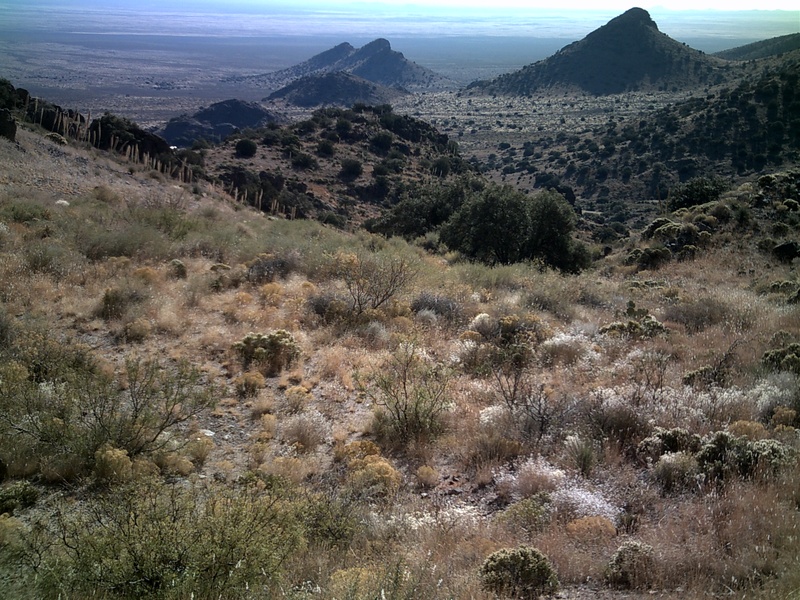
Lobo Draw, is in the heart of the Florida Mountains. The Tres Lomitas are to the Southeast, the San-Tex Mines are just south of those three hills. It is beautiful country, wild and rough. The draws are thick with brush and boulders, the slopes are covered in wild grass, there is an abundance of cactus and yuccas. There is wildlife all around and although isolated, on my first two visits it was crawling with hunters. The trail into the mountain starts at English Well, here a windmill, scattered debris and stock tanks remind us of the area's ranching heritage. At first glance, Lobo Draw looks innocuous, but it tends to get rougher, especially as you start to gain in elevation. One thing I've learned is to stay out of the draws whenever possible. In the draws you either get bushwhacked or find yourself climbing up and down boulders without gaining much ground, the going is easier along the top. While the trail starts at the windmill, you can also drive appox. 1/2 mile to the end of the road where there's another trail. This trail follows a draw up the slope to a clearing, there I found the remnants of a particularly large mine, it's most prominent feature is a number of support rods driven into the rock, held in place by metal plates and bolts. The mines are back-filled and the site has returned to a natural state with the exception of two large tailing dumps. I would've fooled myself into thinking this was the Atir Mine, as I found part of a pipe clamp that was of recent vintage. However, I knew getting to Atir was not going to be as easy as following a trail to its portals.
It was then that I had a rare encounter, as I sat on top of a debris pile, examining bore holes, I sensed that I wasn't alone. Upon standing, I saw an ibex ram standing on the ridge just above the mine opening, appox 50 yards away. It was a fully grown adult, its massive horns curling back, probably 36-40" long, with a full dark beard. Throughout the day I had been serenaded by rifle fire coming from the northeast, the billy it seems had been driven south by the presence of the hunters and right onto my path. The ram stopped, looked at me without spooking and then slowly ambled up the ridge, stopping again to look my way. I quickly reached for my camera, only to realize that I had left it in my pack, back on the trail, opportunity lost! I stood there looking at him, then not knowing what else to do, I whistled, he stopped, reared his head back and slowly continued over the ridge and out of my sight. These animals are elusive, you seldom spot them with binoculars, much less, within eyesight. The Ibex, is a species of wild goat was brought to New Mexico from Iran in 1970, originally 42 Persian ibex were released in the Florida range. One of two exotic game animals transplanted to New Mexico (Oryx or gemsbock were released at the White Sands Missile Range in the late 1960's) The ibex have flourished in the Florida Mountains, The BLM and the Dept. of Game & Fish manage the population, with 400 animals designated as the maximum number the range can sustain. Annual hunts are held to keep the ibex population in check, with hunters selected by lottery. The Ibex have filled an ecological niche in the Florida wilderness , feeding on mountain mahogany, oak, grasses and forbs. In Lobo draw they seem to favor the prickly pear and cholla cactus, as evidence of their feeding on both can be found everywhere on the trails and ravines.
I left the clearing and traversed the slope in a southeastern direction until I came to a finger draw, I followed the draw down (failing to heed my own advice) and promptly found myself fighting my way through a tangle of brush. I worked my way back to the trail and hiked back to my truck, where to my dismay, I discovered my cell phone missing. I had covered about 3 miles total during my hike and the thought of re-tracing my steps this late in the day was not something I wanted to do. I started this blog less than a year ago, but I've been hiking into the mountains around New Mexico much longer than that. I have found cellphones to be very comforting, a lifeline to the world, when I'm out there by myself, knowing that there are no other people nearby (there may not be anyone around for days, weeks or months) The cellphone helps ease my mind, if I get hurt, I'll at least have a chance of calling for help (if there's a signal and I remembered to re-charge the battery) So, I've grown fond of my cell phone, it's a vital part of my pack, I won't hike without one. So now I faced the task of finding my phone, which normally I would tuck into my back pack, but on this day, out of haste and laziness, I had clipped it on my belt, a bad decision as it turned out. Reasoning that the phone had fallen off while making my way through the finger draw, I started from there, when I got back to the tailing pile where I had seen the ibex ram, I called off my search. With my pack and water back at the truck and no means of communication, I decided to return home.
Thursday, February 24, 2011
Runaways and Shotguns
For reasons unknown, two young sisters set off on a trek through the desert wilderness south of Deming. This story resembles the plot of the 2002 Australian film directed by Phillip Noyce; Rabbit Proof Fence. The journey of these two girls was not nearly as expansive as the aboriginal girls in the movie, but nonetheless the older girl survived for five days in a wilderness that was not any less hostile or isolated than the Australian outback.
Sept. 7th 1906 Deming Graphic
Runaways!
On Thursday Aug. 30th, two little Mexican girls aged respectively 8 and 3 daughters of Juan Diaz disappeared from their home. The mother and some of the neighbors scoured the town all that night in a vain search for the missing children. Next morning the civil authorities were notified and a systematic search was inaugurated, resulting in the finding of the younger child about four miles south of town and which indicated that the children were attempting to go to their father who was then at work in the Florida mountains twenty miles away. The search was then extended, the line reaching out eighteen or twenty miles. At a point about eighteen miles out, tracks of the child were found but with night coming on the search had to be abandoned. On the morning of Sept. 3rd. soon after daylight the trail was taken up and the dim footprints of the fleeing child were soon discovered. To elude the officers, the child then hid under the mesquites running and dodging among the bushes, in this manner she succeeded in evading her rescuers until 10 o'clock when she was overtaken and captured. For nearly five days the child had subsisted upon nothing but prickly pears and when found was well, but her hands and feet her face, mouth and tongue were full of cactus thorns.
Two very different reports involving shotguns from the archives of the Deming Graphic. Both are tragic, one an accident and the other deliberate. One happened just as a young boy was on the cusp of manhood and the other ended the pain and suffering of a man who had lived a long life. Shelby Phillips overcame the loss of his right hand to become a prominent and successful rancher in Luna County.
Aged Man Ends His Sufferings
March 15th 1906 Deming Graphic
Last Sunday afternoon about 4 o'clock the people of Deming were greatly shocked on learning that Robert Redding aged 70 years, had committed suicide by shooting himself through the heart with a shot gun. No one witnessed the terrible deed. The full charge passed through his body as large as a man's fist. The whole heart was shot away and the man's body presented a ghastly sight when found. Redding had for the past year conducted a restaurant near the Union depot. Deceased, who had long suffered from asthma and heard to remark, Sunday morning, "I'll never put in another night of suffering like I did last night"
His wife becoming alarmed and knowing that her husband had on several occasions threatened suicide, left the house on Sunday afternoon for a short time to secure some one to spend the night with her husband. Upon her return the body of the unfortunate man was found lying on the floor, dead, with a shot gun and poker lying nearby. The supposition is that Redding placed the muzzle of the gun to his breast over the heart and pulled the trigger with the poker. Redding is an old settler of this section, having come here some thirty five years ago and has resided in Luna and Grant counties ever since.
Runaways!
On Thursday Aug. 30th, two little Mexican girls aged respectively 8 and 3 daughters of Juan Diaz disappeared from their home. The mother and some of the neighbors scoured the town all that night in a vain search for the missing children. Next morning the civil authorities were notified and a systematic search was inaugurated, resulting in the finding of the younger child about four miles south of town and which indicated that the children were attempting to go to their father who was then at work in the Florida mountains twenty miles away. The search was then extended, the line reaching out eighteen or twenty miles. At a point about eighteen miles out, tracks of the child were found but with night coming on the search had to be abandoned. On the morning of Sept. 3rd. soon after daylight the trail was taken up and the dim footprints of the fleeing child were soon discovered. To elude the officers, the child then hid under the mesquites running and dodging among the bushes, in this manner she succeeded in evading her rescuers until 10 o'clock when she was overtaken and captured. For nearly five days the child had subsisted upon nothing but prickly pears and when found was well, but her hands and feet her face, mouth and tongue were full of cactus thorns.
Two very different reports involving shotguns from the archives of the Deming Graphic. Both are tragic, one an accident and the other deliberate. One happened just as a young boy was on the cusp of manhood and the other ended the pain and suffering of a man who had lived a long life. Shelby Phillips overcame the loss of his right hand to become a prominent and successful rancher in Luna County.
A sad accident
Jan 5th 1906 Deming Graphic
While out shooting quail at the ranch of his father, Shelby, the sixteen year old son of James Phillips accidentally shot himself last Friday with a No.12 Winchester shot gun loaded with No.6 shot. While walking over a slick rock the young man slipped and fell, striking the hammer on the rock and breaking it off, thereby discharging the gun. The whole charge took effect in his right forearm, tearing away the thumb and many bones of the wrist. The day was cold and stormy and the thirty mile ride to town, though made as easy as possible, together with the great loss of blood, would have been a severe trial on the strongest man.
Though the hand was in very bad shape an effort was made to save a part of it, but on Sunday night it was seen that the force of the charge had destroyed so much of the arm that further effort to save any part of it would result in death to the boy. Drs. Swope and Steed then amputated the arm just above the elbow. While the great strain on his system for a time seemed more than he could bear and his life seemed almost despaired of, at last a rugged constitution asserted itself, and he is now on the high road to recovery. Though beginning the new year with so great a loss, it may be some consolation to the young man that many of our greatest men have been similarly afflicted. Shelby has the reputation of being an exceptionally good and bright boy, and with these two sterling qualities there is nothing he may not yet accomplish in life.
Aged Man Ends His Sufferings
March 15th 1906 Deming Graphic
Last Sunday afternoon about 4 o'clock the people of Deming were greatly shocked on learning that Robert Redding aged 70 years, had committed suicide by shooting himself through the heart with a shot gun. No one witnessed the terrible deed. The full charge passed through his body as large as a man's fist. The whole heart was shot away and the man's body presented a ghastly sight when found. Redding had for the past year conducted a restaurant near the Union depot. Deceased, who had long suffered from asthma and heard to remark, Sunday morning, "I'll never put in another night of suffering like I did last night"
His wife becoming alarmed and knowing that her husband had on several occasions threatened suicide, left the house on Sunday afternoon for a short time to secure some one to spend the night with her husband. Upon her return the body of the unfortunate man was found lying on the floor, dead, with a shot gun and poker lying nearby. The supposition is that Redding placed the muzzle of the gun to his breast over the heart and pulled the trigger with the poker. Redding is an old settler of this section, having come here some thirty five years ago and has resided in Luna and Grant counties ever since.
Mine Hill
A family outing that took a tragic turn, would forever haunt Chance City and Mine Hill. The tragedy that befell 10 year old Dan Hollenshead brought into clear focus the real and immediate danger that these abandoned mines posed. The accident left local residents and his classmates, grasping to understand how and why this could have happened. The mine workings had been abandoned for years, with little or no effort made by owners and operators to safeguard them prior to shutting down operations. Located in close proximity to the Gage pumping station (operated by El Paso Natural Gas Co). Housing provided at the site was home to a number of families (including the Hollensheads). With so many dangerous and unsecured mine openings nearby, it was an accident waiting to happen. On April 27th 1968, around noon, the Hollenshead family and some friends set out from the Gage Compressor Station. The purpose of the outing was to explore some of the mine openings on the western slope of Mine Hill. Of interest to the group was an adit with a large portal located near a draw at the bottom of the slope. This adit was part of the Hearst, Haggins & Tevis holdings and was first worked around 1882. I have not been able to identify this mine by name, nor have I found any records that identify the mine. Then Luna County Sheriff, C.C. "Slick" Gray told a reporter for the Deming Headlight in 1968, that "It was the old Quincy Mine" however that information was incorrect. Most likely this adit was part of the Jessie Group or Burke Mines, possibly the Little Jessie Mine.
During the 1994 NM-AML safeguard project, the adit was designated as #131, which the contractor spray painted above the portal. The Hollenshead party entered the adit and proceeded an estimated 450ft. into the hillside at which point a vertical shaft intersected their path. This shaft starts at the surface about 200' above where it intersects the adit. It is located amongst a cluster of open stopes and shafts that are now secured with steel netting equipped with bat gates. As Danny's brother Edward climbed around the opening, Danny approached, lost his balance and plunged an estimated 100 ft. into the shaft. A call went out to emergency responders, The Luna County Sheriff's Office, The Deming Fire Dept. & The State Police arrived on site. A radio call went out to the Grant County Sheriff's office to contact R.A. White, Deputy Inspector of Mines for the State of New Mexico in Silver City. White's expertise was needed to determine how much rope would be needed to reach the boy. Lee Pelayo (at the time a Luna County Commissioner) was on the scene, as the lightest member of the rescue party he was lowered into the shaft and recovered the lifeless body. For Pelayo, a World War II POW and Bataan Death March Survivor, it was a heartbreaking experience. The Hollenshead family put up a plaque at the mine opening, now secured with heavy angle iron. A tribute to a young man who in an instant was taken from this world. Not an uncommon occurrence at Chance City, but hopefully the last.
Few reports concerning accidents in abandoned mines have happy endings. New Mexico has experienced at least eight abandoned mine related fatalities in the last 40 years and numerous related injuries. Author Philip Varney (New Mexico's Best Ghost Towns) writes of a conversation he had with an EPNG employee at Gage, who told him that he was the replacement for another employee who was found at the bottom of a mine shaft at Chance City. However the NM-AML has no record of this accident nor have I found any mention of it in local newspaper archives. The accident that took the life of young Dan Hollenshead, in 1968, led to the safeguard efforts at Chance City. However, there was a lapse of 26 years between the time New Mexico Inspector of Mines, William Hays filed the report and when it resurfaced. NM- AML Bureau staff made securing the mine openings at Chance City a priority once they became aware of the tragic events. In 1994 the project was launched to safeguard all the abandoned mine adits, shafts and open stopes on Mine Hill. The project started on June 14th 1994 and was completed by October 2nd. 1994. In all, 164 mine openings were identified for safeguarding. The NM- AML Bureau worked with UNM bat biologist J. Scott Altenbach, to identify the mine openings and features used by bats and owls as habitat. The Museum of New Mexico also conducted a survey of the site and recommended that the remaining ruins of Chance City and other surface features such as head frames, timber load outs, hand laid rock retaining walls and even trash piles be preserved.With many of the openings located high on the steep hillsides, getting the materials to construct grates and bat closures proved problematic. Using explosives, polyurethane foam plugs and by back filling, the contractor secured over 130 mine openings. On the western slope, a system of open stopes and shafts were enclosed with heavy steel netting that allows bats to exit and enter while keeping humans from falling in. Where the openings were not accessible to heavy equipment or vehicles, men carried the materials up the steep hillsides. What leads someone into a mine opening? For some mine explorers the need to know or see what is inside, motivates them, yet most of the time there is nothing to see inside a mine shaft. However this intuitive curiosity can cause a normally cautious person to ignore safety concerns. The key to safety around mine openings is to visually establish an immediate safety zone, If it doesn't look safe, it probably isn't. Dan Hollenshead was a classmate, I attended Smith School with him. I remember him as a good natured, lanky kid, always up for a game of kick ball or tag. Whenever I venture out to the Victorios, I stop by adit 131 for a quick prayer and sometimes a verse of Danny Boy, always in the hearts and memories of those who knew him.
Ye'll come and find the place where I am lying
And kneel and say an "Ave" there for me.
And I shall hear, tho' soft you tread above me
And oh, my grave shall warmer, sweeter be"
This is the report of the accident as printed by the Deming Headlight:
Youngster killed in mine mishap
A family outing Saturday ended in tragedy for Mr. and Mrs. Daniel Hollenshead of Gage when their son, Danny Waller Hollenshead, 10, fell more that 100 feet to his death in a mine shaft. The family and some friends were exploring an old mine about 20 miles west and five miles south of Deming near the El Paso Natural Gas Co. site when the accident occurred. According to Sheriff C.C. "Slick" Gray, it was the old Quincy Mine, which was originally mined by the Spanish and worked again in the early 1900's. The group had gone about 450 feet into the mine by means of a lateral shaft to a point where a vertical shaft crossed their path. Investigating officers stated that Danny was watching his brother, Edward climbing up in the vertical shaft and lost his balance, plunging down into the pit. An emergency call to the Sheriff's Dept. brought members of the Fire Dept., Sheriff's Dept. and State Police to the scene as well as County Commissioner Lee Pelayo. As the lightest member of the party, Pelayo was lowered on a rope to recover the boy's body.
In addition to his parents and brother, Danny is survived by his sister, Karen and both sets of grandparents, Mr. and Mrs. C.D.Hollenshead of Hot Springs,Ark. and Mr. and Mrs. L.E. Lehman of El Paso. He was born Feb. 22, 1958 in El Paso and was a fourth grade student at Smith School. He lived in Gage for the past two years and was a member of the Methodist Church. Memorial services were held at Wheeler's Chapel at 10 a.m. Monday, the Rev. James Miller of El Paso officiating. Burial was scheduled for 10 a.m. Tuesday in Restlawn Cemetery in El Paso with the Rev. Miller also officiating at the graveside services.
Chance City
"Leave nothing but footprints, Take nothing but photos, Break nothing but silence."
Chance City is dying. It's alarming how rapidly the ruins are deteriorating. Some of the deterioration can be attributed to the natural effects of weathering and time, however I attribute much of it to vandalism. John Wayne is famously credited for having said “Life is tough, but it’s tougher when you’re stupid.” this could be amended to say "Life is tough, but it's tougher when others are stupid," For someone to journey out to such an isolated site in order to destroy something is the lowest form of stupidity. Since my first visit in 1997, Chance City has been on my mind. Like a rock stuck in my shoe, I couldn't ignore it. I've made dozens of trips to the site, spending countless hours tramping up and down the slopes. I've sat for hours on nearby hills studying the layout and connecting the dots. It has taken a vast amount of research and effort to peel back the layers and understand what took place there. With such an enormous amount of mining activity packed into a moderately sized area, this turned into a complicated project. However I loved every minute of it, as The Victorio Mountains became my cathedral. Four miles to the north, the community that grew around the train stop at Gage would survive. The construction of U.S. Route 80 and the advent of automotive travel would give it new life. A motel, diner and service station were built, all in a faux Californian mission style. The place would thrive as an oasis in the desert on the human highway to California. What finally did kill Gage was the same thing that had saved it, progress. Since it was located on the south side of the Southern Pacific Railroad (by rule all townsites were plotted south of the railroad tracks) when I-10 was constructed, it left the townsite sandwiched between the tracks and the interstate. A modern travel stop was built south of the interstate and it slowly drained commercial traffic away from Gage. By 1980 the abandoned buildings were in ruins, they would soon be razed and the site cleared
After pouring over topographical and satellite maps, I still found myself unable to identify most of the mines. With so many mines concentrated in one area, it's difficult to pinpoint the exact location of certain mines. Starting from the north, the group of mines in the vicinity of a rock retaining wall include; the Parole mine and the Arizona Lode. Just above these mines there is a rock formation with a cave like opening that serves as habitat for both bats and owls. Further along the path is a draw that leads to an adit, this is the site of the tragic Hollenshead accident. This adit has a natural draft flowing through it, the air temperature is always colder than the ambient temperature. During the summer months a strong barn yard smell emanates from the portal, indicating the presence of a large bat colony. It's a long adit (possibly as long as 500ft.) intersected by a deep vertical shaft that plunges to about 300 ft. This adit, like the open stopes and shafts located just above and to the south, could be part of the Jessie Group. Slightly below that area is an adit of indeterminate length. There is no air flow, suggesting that it does not connect to any open shafts or stopes. At about the same elevation further to the south there is a hopper, just behind that is a large mine opening, it's been back-filled so it's hard to tell if it was a vertical or inclined shaft. This site resembles a quarry more than a mine, it features a jumble of boulders similar to those at The City of Rocks State Park
Further to the south Chance City unfolds before us. It never had the old west flavor of Shakespeare or the ghostly mystique of Cooks. It did however, have a good run as a rough and tumble mining town. The buildings were sporadically spaced along the main street. These adobe and rock dwellings were built on the east side of the road, facing west. They were basic and simple structures with dirt floors, wood frame windows and wooden doors. Judging from the trash piles that dot the hillside, many of the miners pitched tents along the avenue or further down the slope. The trash piles consist of lard buckets,coffee tins, tobacco tins, evaporated milk cans & sardine tins, the staples of life before refrigeration. Water was a prized commodity, that was brought in by wagon from Gage. There was water to be found, today a windmill pumps the life giving liquid from the ground. It's hard to believe that the same wasn't done back then. For many of the miners, Chance City was just another stop in their quest for Eldorado. They came and went suffering all hardships along the way, determined that the next shaft would bring their bonanza. Here, in the midst of the remnants and ruins, the trappings of the distant past remind us, that for some, the pageant of life came to a sudden and violent end at this site. Ripped from this mortal coil you sense that their spirits still linger about.
Beyond Chance City is a cluster of mines grouped along the road near the windmill.The mine with the head frame is either the Rover or the Sidewiper, The head frame leans at a 45 degree angle, however it once stood upright. It's hard to tell if this happened naturally or is the work of vandals. This mine is of an indeterminate depth with an unknown number of working levels. Elevated from ground level, The Rambler (300') is next to some concrete slabs that were part of a hoist system. The Excess (60' shaft w/150' drift) is lined with metal pipe anchored to the sides with poly foam. At the southern end of the West Slope there was a system of inclined shafts, vertical shafts and open stopes that have been back-filled, with the exception of one shaft (60-80' deep) that is not sealed or has been breached. Just below this shaft there is a large area, bare of vegetation where fissures have occurred over open stopes that were back-filled.
At the extreme southwestern edge of Mine Hill, the Helen and Josephine Lode mines string out along the lower edge of the hill wrapping around the slope. The head frame for the Helen Mine rises alongside the pipeline service road, amidst a scattering of debris. The Helen shaft drops appx. 200 feet down to the working levels. A gated road connects the western side of the hill to the eastern slope, it forks off with one branch leading to the summit and another leading to the Chance Lode mines. The Last Chance mine was owned and operated by George Hearst and his group of investors. The 300' deep shaft, now secured with an impressive metal grate, leads to an extensive underground network of tunnels and shafts (est. 7,000' to 8,000' total length). At their peak, the Hearst, Haggins & Tevis owned Chance Lode and Jessie group mines were the most profitable and productive in the district. One level below the Chance mine an imposing rock wall forms the foundation for the roadbed above. The extent of the underground works is evident by the immense tailing dump below this level.
The southern slope of Mine Hill curves north between the Helen Mine and Mineral Hill. The Daisy, November and December claims are a small cluster of mines located just short of the midway point. This site consists of a small adit with two open shafts in the roof. To the east is a large open stope that doesn't connect to the adit. This stope drops about 50'-70' with a drift that cuts to the northwest at the bottom. Above this site there are 3-4 shafts (The Star claim?) while to the east, at the same elevation, I found an opening into a narrow shaft that drops at least 100'. The lack of tailing at the site would indicate that this is a natural shaft. Mineral Hill, at the southeastern point of the mountain, was the site of ample activity. The Advance, Independence & Crackerjack claims are located near the top of the hill. An adit cuts into the hill for about 80', with a parallel drift of an unknown length located above it. There is a winze that drops down 30' to 40', leading to a drift that runs northwest, also of an unknown length. Both the adit and winze double as a home for a colony of bats, just inside the adit, I found a cluster of bats roosting on the roof. A larger variety of bats was swooping in and out of the winze as I approached. West of Mineral Hill on the slope, there is a series of connecting open stopes ( Armistice claims?) and a deep inclined shaft (The Esperanza?) On the slope facing to the northeast there is a cluster of shafts that made up the Virginia Claim. A washed out road that climbs to the northwest, leads to the Victorio and Southern Pacific prospect shafts, that were also part of the Hearst, Haggin & Tevis holdings. On the northwestern slope, facing the quarry, there are some scattered prospect shafts and one aborted adit. (Tipton Lode or Verdun Claim?)
The Tungsten Hill prospects (including Quarry Hill) extend to the southwest over an area of appx. 1 sq. mile. Directly west of Mine Hill, there is a group of prospect shafts of varying depth situated along the slopes of a craggy hill. In the valley behind this hill, accessible by a bumpy service road is the Irish Rose mine. This was the site of much activity and while it was never built up to the degree of Chance City, a small camp was established. There are a large number of prospect shafts, pits and trenches, The Irish Rose was the most productive, the 150' inclined shaft connected to a number of shafts and stopes. The site is marked by an enormous debris field of tailing and trash, the Irish Rose mine is not secured, but entering it, is not recommended. As the name would suggest, the miners dug for tungsten and beryllium in this area, well after the brief boom at Chance City had passed.
The Victorio Mining District
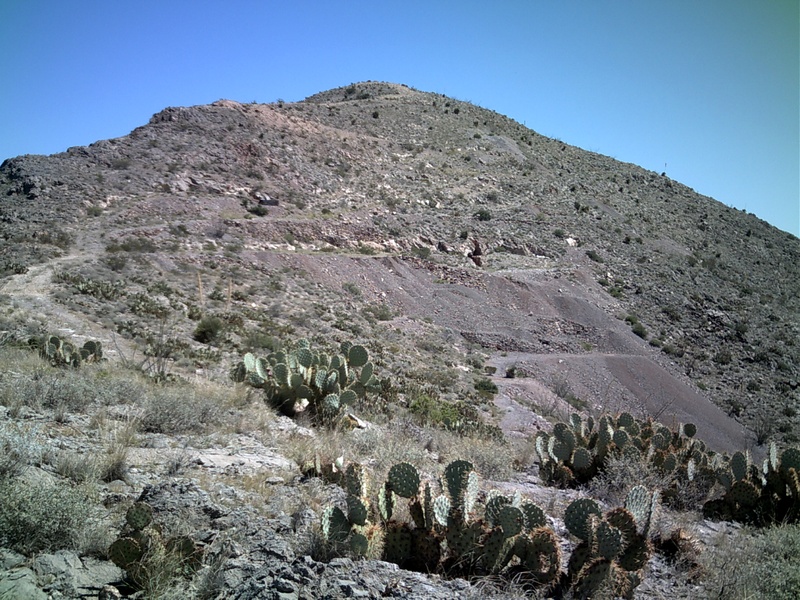
The Victorio Mountains are located 20 miles west of Deming, 3.5 miles from Gage,N.M. The range runs north to northwest, the elevation of the highest peak is 5,375 ft. The range is made up of volcanic ridges and sedimentary rock rising above the surrounding plain. The first ore deposits were discovered by prospectors in the late 1870's. At that time this part of the territory was in the grips of a panic brought on by repeated Apache raids and depredations. The prospectors or any mining men for that matter did well just to get back alive. Further exploration or exploitation of the ore deposits would have to wait until the arrival of the railroad. Between 1880 & 1882, the mining firm of Hearst, Haggin, Tevis & Co. bought into the Last Chance Mine and The Jessie Group mines. This influx of operating capitol was the catalyst that set off the Victorio boom. George Hearst was known as an expert prospector and a shrewd judge of mining properties. Starting in the 1850's he navigated his way around the west seeking out and buying some of the richest mines in the country. The Comstock Lode, The Ophir (both in Nevada) The Ontario (Utah), The Homestake (South Dakota), The Anaconda Copper Mine (Montana) and The Cerro de Pasco Mine in Peru were all Hearst,Haggin,Tevis & Co. properties
The proximity of the mines to the railroad and a smelter at Benson,Az. made the venture attractive. Hearst may have been looking for a much bigger strike at Victorio, but the payout was still much larger than their investment. Most of the mining activity in the district took place at Mine Hill, the southern most feature of the Victorio Range. From above Mine Hill resembles an overturned rowboat, with three distinct slopes facing, west, south and north east. The outcrop rises at a moderate rate to 4,871 ft. At the summit there is an undecipherable inscription gouged into rock that reads "Aug. 1882, XXM No.1, JT Reed USMDS." Below the summit facing west, Chance City and a majority of the mines occupy the slope. The Hearst owned Chance mine (aka Last Chance) is located just below the ridge along the southern slope. Most of the southern slope was untouched except for those mines concentrated between the Chance mine and the Helen Mine. There was sporadic activity on the northeastern slope, mostly on and around Mineral Hill. With the exception of a few prospect digs, little activity took place on the part of the slope facing towards Quarry Hill. The western slope saw the most activity with several mines located close to the foot of the mountain. It is lined with paths to and from the mines, all connecting to a main road that runs through the heart of Chance City. The townsite was laid out quickly, wood frame, adobe and rock dwellings sprang up, a general store was established as were two saloons, a boarding house, blacksmith shop and all the usual entrepreneurial establishments associated with boom towns. At it's peak Chance City (also known as Victorio) was home to appx. 200-300 hardy souls. The Southern Pacific Railroad stop at Gage (3.5 miles away) brought a stream of men to work the mines or in some cases to work the miners. Chance City located in rough country became known as a rough place. Men met violent death either in the mines or at the hands of their fellow man. Despite it's reputation Chance City was probably no more violent or dangerous than most mining camps in the New Mexico territory. A post office was established in 1885, but would close the following year. The mining boom quickly peaked and by 1887 most of the gold and silver ore had been mined out. Mining operations would continue at Mine Hill as new investors and speculators bought in and took their chances. The deeds to the mines would be sold back and forth between the unscrupulous and the unsuspecting.
Chance City clung to life for several years after the initial rush had subsided. Though It seems that by the turn of the century, Gage and Chance City were all lumped together as one locale. The number of people still working or living at Chance City during that time is unknown. However records do show that Chance City could still be a hard and violent place. Mahoney Mortuary's records list several people who met their demise at Gage (this included Chance City) On Nov. 15th 1906 an unknown man was "killed at Gage" probably a mining accident. Pablo Hermanez died in a mine accident on the 22nd. of Dec. 1906. D. Mendoza was shot to death at Chance City on the 25th of Oct. 1907. On the 3rd. of Nov. 1907 an unknown Mexican man's death was reported as "Accident,Cars" this probably refers to railroad cars. Martin Amador was "Hanged" on the 13th of Jan. 1907 (there is no mention if this was a vigilante action, a suicide or an accident) Jane Hodgdon died 3/30 of 1908 a victim of pneumonia and on May 21st. 1908 a child (last name Bosworth) died of unlisted causes. Gage is not mentioned again in these records after 1908. It appears that after 1908, Chance City was abandoned and the population at Gage had dropped dramatically. A cemetery was never established at Chance City or anywhere in the Victorio Range. Nor have I found any solitary gravesites in the vicinity, as is often the case at other mining camps. I can only surmise that with the railroad close by, it was easier to ship the deceased elsewhere for burial.
For those interested in New Mexico Mining Camps & Ghost Towns, there are two books that you must have. You can't tell your ghost towns apart without them. "Ghost Towns and Mining Camps of New Mexico" authored by James E. & Barbara H. Sherman, first published in 1975. And Philip Varney's "New Mexico's Best Ghost Towns" first published in 1981. These are vital guides for anyone interested in mining camps or ghost towns in New Mexico. However, there is a discrepancy that's found in both books:
William Randolph Hearst did not own any mines at Victorio. In 1880 he would have been 17 years old, and even if he was highly precocious, running a mining empire was probably beyond his abilities. It was his father George Hearst in partnership with James Ben Ali Haggin and Lloyd Tevis that bought into the mines at Victorio. This error first appeared in T.M. Pearce's "New Mexico Placenames" with both the Shermans and Varney books repeating the mistake.
Some common misconceptions about the Victorio Mining District:
1. The mines at Victorio were not a bust; between 1880 and 1904 anywhere from $1,150,000 to $1,600,000 worth of ore was assayed and shipped from nearby Gage. After 1887 the production tapered off drastically, but even at that, the New Mexico bureau of Mines and Mineral Resources reports that between 1880 and 1957 (the last year of any known activity) $2.3 million worth of lead, zinc, silver, gold, and copper were mined from that district. Not Comstock, Homestake or Ophir numbers, but for Hearst, Haggin & Tevis the venture was profitable.
2. Victorio Peak, infamous as the site of Doc Noss's "lost treasure" is not located in the Victorio Mountain range. That Victorio Peak is located in the Hembrillo Basin near the San Andres Range. The Victorio Mountains unlike Doc Noss produced actual gold.
3. The travel center at the present day Gage exit is not Gage. This site has long been referred to as either Continental Divide or Butterfield Station. It is owned by the Bowlin Corp. that operates the store and the Dairy Queen. Gage was located to the north between the railroad tracks and the interstate, that site has been razed and cleared.
4. The lead character in the 2007 movie, "There Will be Blood" is not modeled on George Hearst. The movie loosely based on Upton Sinclair's novel "Oil" features a protagonist named Daniel Plainview. Director Paul Thomas Anderson revealed that the character was based mostly on the life and times of Edward L. Doheny, who made an enormous fortune in oil after starting out as a silver prospector in Kingston,N.M. However, George Hearst is included as one of the main characters in the HBO television series "Deadwood."
1. The mines at Victorio were not a bust; between 1880 and 1904 anywhere from $1,150,000 to $1,600,000 worth of ore was assayed and shipped from nearby Gage. After 1887 the production tapered off drastically, but even at that, the New Mexico bureau of Mines and Mineral Resources reports that between 1880 and 1957 (the last year of any known activity) $2.3 million worth of lead, zinc, silver, gold, and copper were mined from that district. Not Comstock, Homestake or Ophir numbers, but for Hearst, Haggin & Tevis the venture was profitable.
2. Victorio Peak, infamous as the site of Doc Noss's "lost treasure" is not located in the Victorio Mountain range. That Victorio Peak is located in the Hembrillo Basin near the San Andres Range. The Victorio Mountains unlike Doc Noss produced actual gold.
3. The travel center at the present day Gage exit is not Gage. This site has long been referred to as either Continental Divide or Butterfield Station. It is owned by the Bowlin Corp. that operates the store and the Dairy Queen. Gage was located to the north between the railroad tracks and the interstate, that site has been razed and cleared.
4. The lead character in the 2007 movie, "There Will be Blood" is not modeled on George Hearst. The movie loosely based on Upton Sinclair's novel "Oil" features a protagonist named Daniel Plainview. Director Paul Thomas Anderson revealed that the character was based mostly on the life and times of Edward L. Doheny, who made an enormous fortune in oil after starting out as a silver prospector in Kingston,N.M. However, George Hearst is included as one of the main characters in the HBO television series "Deadwood."
High Noon in Deming
Deming newspapers in 1906 were not all that different from their modern successors. The bulk of news reports and articles came from national wire feeds. The newspapers published once a week and were heavy with ads and advice columns that covered everything from health to wealth. I've found that it takes a keen eye to cull the local stories of interest from the spam of yesteryear. For instance neither one of the Deming newspapers ran this story on the front page. You sense the reluctance on the part of both editors to report the incident. Both papers took great pain to draw a line between their reporting and the waves of gossip that seemed to have engulfed the community. This unlikely gunfight between a school principal and the superintendent of schools, rocked the small community to it's very core. However no mention of any resulting court action or criminal charges were reported in the following months. The motive behind this bizarre duel, between two professional educators remains a mystery. Within a week, New Mexico Territorial Gov. Hagerman, appointed A.A. Temke of Deming to be superintendent of public schools of Luna County replacing the late Prof. U. Francis Duff.
The following articles are posted here as they appeared in 1906. A short article published in the New York Times (Apr. 30th 1906) gives us some insight as to the dueling duo's state of mind. An in-depth report published on May 3rd. 1906 in The Deming Headlight, the assumed author is editor George L. Shakespeare. The story as reported by the Deming Graphic on May 4th 1906, which was probably authored by editor and proprietor A.L. Sangre. Also included is a letter submitted to The Deming Headlight by an anonymous source and published on May 10th. 1906. That letter describes U. Francis Duff as a gentle soul, beloved and well liked by all who knew him. The public opinion of his killer may not have been as generous. Prof. U. Francis Duff was buried at Mountain View cemetery in Deming, N.M. in the Old Masonic Section. In 1955 his beloved wife Emma, was laid to rest beside him. W.H. Dickey and his family seem to have left Deming shortly after his recovery from the bullet wound. What was the cause? Only Profs. Duff and Dickey really know what caused both to deviate from their normal character. Over the years very little information leaked out concerning the incident. Only the gossip and rumors that spread around the town after the shootings provide any insight as to the reasons behind the duel. It seems that rumor of an affair between Prof. Duff and the wife of Prof. Dickey had been circulated. It is believed that rumors of this illicit affair had been started by Duff himself. Dickey confronted Duff about the situation, with Duff neither denying nor confirming his involvement. This quickly poisoned any relationship (personal or professional) between the two highly respected educators. Dickey's wife soon became pregnant and more rumors spread concerning who the father really was. After the child was born (the infant boy was less than a year old at the time the shooting took place) Duff supposedly claimed that the child was his, when word of this spread to Dickey, he confronted Duff and asked him to take back his statement and apologize. Duff not only refused but he told Dickey that the next time he saw him he would shoot him dead on sight. Thus the stage was set for one of the strangest (and one of the last) gunfights the old west would ever see.
Educators in Duel!Prof. Dickey kills Prof. Duff, Superintendent of Schools
Special to the New York Times, Dateline: Deming, N.M. April 29th 1906
Prof. W.H. Dickey, Superintendent of Deming Public Schools, today shot and instantly killed Prof. U. Francis Duff, Superintendent of Luna County Schools, one of the most prominent educators in New Mexico and a student of archaeology. Who had achieved a National reputation by his writings. The shooting took place shortly after noon in front of the Post Office in the main street of Deming. Dickey had been driving about town in a buggy during the morning and had passed Prof. Duff several times. As he drove in front of the Post Office, Duff stepped out drawing a revolver and called Dickey to stop. Dickey drew his revolver, leaped from the buggy and opened fire. Both pistols cracked at once, Prof. Duff fell dead with a bullet through his head. Dickey was shot in the side, but is not believed to be fatally hurt. For some months there had been enmity between the men arising from differences in connection with the management of the Deming schools, although it is hinted that personal matters have also entered into the quarrel. It is said that Duff had frequently threatened to shoot Dickey on sight.
An Awful Tragedy Deming Headlight May 3rd. 1906
It is with the most intense personal dislike that the Headlight makes any mention of the awful tragedy that was enacted upon the streets of this city last Saturday at about fifteen minutes of twelve o'clock, where one of our good citizens lost his life and another now lies on a bed of pain, suffering pangs of sorrow and regret. Last Saturday at the hour mentioned, U. Francis Duff, superintendent of schools for Luna county and assistant principal of Deming Public Schools, stepped to the edge of the sidewalk at the post office corner and called to W.H. Dickey, principal of Deming Public Schools, who was driving west on Spruce street; "Stop Here" Dickey at once stopped and as Duff was advancing on him with a pistol, called; "See what that man is doing, stop him." at the same time springing into the ground on the opposite side of his buggy and drawing a pistol. Instantly two reports that were so close together that for a time many who heard them declared there was but one rang out. Prof. Duff lay on the ground with a bullet wound in the head a little to the left of the center of the forehead and Prof.Dickey shot in the left front side was running toward Henry Meyer's Meat Market at the opposite corner of the square as Dickey ran he looked back at Duff lying on the ground and exclaimed "My god he is dead, I didn't mean to kill him"
Duff was at once carried to Doctor S. M. Strong's office on the opposite side of the street, where a hasty examination of the wound disclosed the fact that the bullet had penetrated the brain and it would be only a question of a few hours at the most before he would pass away. Dickey was placed on a bed in a rear room of the meat market and an examination of his wound,which was in the left side, just below the heart, showed that the bullet had gone around, probably following a rib, and that while it might be of a serious nature, he was in no immediate danger. Kind friends took him to his home, where a little later on, an operation was performed and the bullet extracted. Prof. Dickey at this writing is resting comfortably and doing as well as could be expected and should no unlooked for complications arise will be out again in due time. Prof. Duff died from the effect of his wound at 7 o'clock Saturday evening. The above are the bare facts of this most deplorable affair. As to the cause of this most unfortunate encounter, we doubt if any one in this community outside of the immediate members of the families of each of the participants in this duel to the death have any knowledge. One thing is certain, the private differences of these two men was no affair of The Headlight and while there is any amount of surmise and hurtful gossip going the rounds, doing no one any real good, except that it may satisfy the cravings of a gossiper, we have nothing to say regarding the matter, other than that it is the opinion of the citizens in this town that too much has already been stated by parties having no knowledge of whereof they speak.
Both Prof. Duff and Dickey are highly educated, cultured and well bred gentlemen, both were members of the Presbyterian Church and active workers in that institution of Christianity. Both were members of the Masonic Order, Duff particularly being a mason of high standing in the McGorty Commandry of this city. The deceased leaves a family consisting of a loving wife and two interesting daughters, who have the heartfelt sympathy of this whole community in this their great bereavement. Prof. Dickey also has a loving wife and two little children, one a boy of five years and the other an infant about one year old. The brother of Prof. Dickey, Mr. G.L. Dickey arrived Sunday evening from his home in Tyler Tx. and is attending closely at the bedside of his brother.
Originally U. Francis Duff came from Ohio, of which state he was native although for some fourteen or fifteen years past he has been a resident of this territory and was largely known in educational circles throughout the south west. He was a writer of considerable note, many of his articles having been published in the leading periodicals of the east from time to time. For the past eight years he had held the position of assistant principal of the Deming Public Schools and beloved by all of the scholars who in that length of time were under his tuition. For the past four years Duff held the offices of superintendent of schools of Luna County. At the last election he was elected on the Republican ticket over his Democratic adversary, by a large majority. His remains were laid to rest in the Masonic Cemetery last Sunday afternoon, services being conducted by Deming Lodge No.12 A.F. & A.M. W.H. Dickey came here three years ago as superintendent of the public schools and has given general satisfaction to all in that capacity. He also is a man of rare educational attainments and by his superior knowledge and thoroughness has succeeded in placing the schools of this city on the very highest plain, in fact under his immediate supervision our public Schools stand in a most enviable light today as compared with like institutions any where else in the territory. Mr. Dickey is a native of Tennessee although, we believe he taught some of the best schools in the state of Texas before he came here.
Deming Shocked!
A fatal Mid Day Duel. One Killed, Another Wounded
San Francisco received the most severe shock in its history on the 18th of last month and Deming was shocked as never before by the terrible tragedy of last Saturday. Already the press dispatches have given the public an account of the matter most of which are in the main correct. Prof. W.H. Dickey principal of our public schools, and Prof. U. Francis Duff principal of the high school and county superintendent of public schools, on Saturday last met at the post office just before the hour of twelve both armed and prepared for the meeting, and without any waste of words fired at each other at the same instant. Prof. Duff fell shot through the brain and Prof. Dickey wounded in the left side walked across the street to Mr. Meyer's market and was from there taken to his home. Prof. Duff was carried across the street to the office of Dr. Strong, where without regaining consciousness he died about seven o'clock of the same day.
Both were teachers in the same school, both occupied the same recitation room for nearly three years; were prominent members of the Presbyterian church and active in Sunday School and Christian Endeavor work. Both were members of the Masonic order. Prof. Duff was a Knight Templar and at the John Paul Jones memorial services on Thursday evening delivered one of the finest addresses ever heard in Deming. We observe that some of the daily newspaper correspondents undertake to give reasons for this bloody tragedy. So far as we have given them perusal they are only rumors and surmises, part of the town tittle tattle. Gossip may have had its part in the causes that led to this fatal encounter and perhaps if there had been no cruel tongue wagging there would have been no tragedy. We say perhaps for we believe the true reasons have
never been made public. Since we first met and became acquainted with these prominent educators and active church workers, our relations have always been brotherly and cordial and to us nothing could have seemingly been further from their hearts than a feeling of enmity toward each other. We rejoice to know that Prof. Dickey's recovery is assured and that he will soon rally from the shock and the wound. He is still a young man and we hope a long life of usefulness in in store for him.
Prof. Ulysses Francis Duff was born in Mt.Pleasant, Ohio on Aug. 17 1865. He was educated at Bellair, Ohio and received a degree from the Chicago Univ. He was authority on archeological researches has been in the employ of the government in work for the Smithsonian Institute among the cliff dweller ruins, and has written along this line for several eastern and western magazines. That he was under some great mental excitement for several days was known to a number of his most intimate friends. As an evidence of his condition, we add to this notice a part of a poem that was begun or as we say, blocked out but never finished, and was evidently one of his last pen productions.
"Is with me always....thy rough, lone nights and days
The swishing rod....the anguish of the flesh
The tortured spirit.... that no look betrays
The opening of the old sad stripes afresh
prostrate and praying, as my soul doth live
out of the ashes.... at thy feet i fall
only one word....one word...forgive."
Prof. Duff was buried from the Presbyterian Church at 3 o'clock Sunday afternoon, Rev. W.H. Dubose officiating with Masons and Eastern Star members in attendance. A wife mourns the loss of a husband, two daughters of a father, to whom the great heart of our stricken community goes out in loving sympathy. And to him who holds his children in the hollow of his hand, a united prayer that he will be a father to the fatherless and in very deed the widow's god.
In Memorium of U. Francis Duff (anonymous, published in the Deming Headlight May 10th. 1906)
In the passing of this life from our midst in the prime of its years and usefulness, there has come with its sudden closing an emptiness in the room of his frienships, difficult and painful to realize. With the wealth of bloom laid upon that new made grave, went many a warm tribute to the kindly, generous, impulsive quantities that had won and held so large a portion of confidence and esteem. The bright and cultured mind and the cherry, sympathetic manner that went with it. The warm heart, the open, friendly, helpful and spontaneous cordial hospitality, the quiet beauty of his home and family life. These were the things that turned simple social intercourse into enduring regard. Friends came to him unbidden and the loving heart of youth and childhood followed him with trustful affection. In the supreme test of duty ,honor and courage, that comes to but few, he bore himself as a man and in none of these was he found wanting. From the place he made fragrant with the perfume of gentle deeds and words, the strong yet kindly spirit that takes the hand of each in turn, had led him forth into the larger spaces of eternity. In the wide western land he loved so well and which he never felt to be a far or lonely country, his grave is made; but with those who know him best he leaves a gracious memory that will not pass.
An Awful Tragedy Deming Headlight May 3rd. 1906
It is with the most intense personal dislike that the Headlight makes any mention of the awful tragedy that was enacted upon the streets of this city last Saturday at about fifteen minutes of twelve o'clock, where one of our good citizens lost his life and another now lies on a bed of pain, suffering pangs of sorrow and regret. Last Saturday at the hour mentioned, U. Francis Duff, superintendent of schools for Luna county and assistant principal of Deming Public Schools, stepped to the edge of the sidewalk at the post office corner and called to W.H. Dickey, principal of Deming Public Schools, who was driving west on Spruce street; "Stop Here" Dickey at once stopped and as Duff was advancing on him with a pistol, called; "See what that man is doing, stop him." at the same time springing into the ground on the opposite side of his buggy and drawing a pistol. Instantly two reports that were so close together that for a time many who heard them declared there was but one rang out. Prof. Duff lay on the ground with a bullet wound in the head a little to the left of the center of the forehead and Prof.Dickey shot in the left front side was running toward Henry Meyer's Meat Market at the opposite corner of the square as Dickey ran he looked back at Duff lying on the ground and exclaimed "My god he is dead, I didn't mean to kill him"
Duff was at once carried to Doctor S. M. Strong's office on the opposite side of the street, where a hasty examination of the wound disclosed the fact that the bullet had penetrated the brain and it would be only a question of a few hours at the most before he would pass away. Dickey was placed on a bed in a rear room of the meat market and an examination of his wound,which was in the left side, just below the heart, showed that the bullet had gone around, probably following a rib, and that while it might be of a serious nature, he was in no immediate danger. Kind friends took him to his home, where a little later on, an operation was performed and the bullet extracted. Prof. Dickey at this writing is resting comfortably and doing as well as could be expected and should no unlooked for complications arise will be out again in due time. Prof. Duff died from the effect of his wound at 7 o'clock Saturday evening. The above are the bare facts of this most deplorable affair. As to the cause of this most unfortunate encounter, we doubt if any one in this community outside of the immediate members of the families of each of the participants in this duel to the death have any knowledge. One thing is certain, the private differences of these two men was no affair of The Headlight and while there is any amount of surmise and hurtful gossip going the rounds, doing no one any real good, except that it may satisfy the cravings of a gossiper, we have nothing to say regarding the matter, other than that it is the opinion of the citizens in this town that too much has already been stated by parties having no knowledge of whereof they speak.
Both Prof. Duff and Dickey are highly educated, cultured and well bred gentlemen, both were members of the Presbyterian Church and active workers in that institution of Christianity. Both were members of the Masonic Order, Duff particularly being a mason of high standing in the McGorty Commandry of this city. The deceased leaves a family consisting of a loving wife and two interesting daughters, who have the heartfelt sympathy of this whole community in this their great bereavement. Prof. Dickey also has a loving wife and two little children, one a boy of five years and the other an infant about one year old. The brother of Prof. Dickey, Mr. G.L. Dickey arrived Sunday evening from his home in Tyler Tx. and is attending closely at the bedside of his brother.
Originally U. Francis Duff came from Ohio, of which state he was native although for some fourteen or fifteen years past he has been a resident of this territory and was largely known in educational circles throughout the south west. He was a writer of considerable note, many of his articles having been published in the leading periodicals of the east from time to time. For the past eight years he had held the position of assistant principal of the Deming Public Schools and beloved by all of the scholars who in that length of time were under his tuition. For the past four years Duff held the offices of superintendent of schools of Luna County. At the last election he was elected on the Republican ticket over his Democratic adversary, by a large majority. His remains were laid to rest in the Masonic Cemetery last Sunday afternoon, services being conducted by Deming Lodge No.12 A.F. & A.M. W.H. Dickey came here three years ago as superintendent of the public schools and has given general satisfaction to all in that capacity. He also is a man of rare educational attainments and by his superior knowledge and thoroughness has succeeded in placing the schools of this city on the very highest plain, in fact under his immediate supervision our public Schools stand in a most enviable light today as compared with like institutions any where else in the territory. Mr. Dickey is a native of Tennessee although, we believe he taught some of the best schools in the state of Texas before he came here.
Deming Shocked!
A fatal Mid Day Duel. One Killed, Another Wounded
San Francisco received the most severe shock in its history on the 18th of last month and Deming was shocked as never before by the terrible tragedy of last Saturday. Already the press dispatches have given the public an account of the matter most of which are in the main correct. Prof. W.H. Dickey principal of our public schools, and Prof. U. Francis Duff principal of the high school and county superintendent of public schools, on Saturday last met at the post office just before the hour of twelve both armed and prepared for the meeting, and without any waste of words fired at each other at the same instant. Prof. Duff fell shot through the brain and Prof. Dickey wounded in the left side walked across the street to Mr. Meyer's market and was from there taken to his home. Prof. Duff was carried across the street to the office of Dr. Strong, where without regaining consciousness he died about seven o'clock of the same day.
Both were teachers in the same school, both occupied the same recitation room for nearly three years; were prominent members of the Presbyterian church and active in Sunday School and Christian Endeavor work. Both were members of the Masonic order. Prof. Duff was a Knight Templar and at the John Paul Jones memorial services on Thursday evening delivered one of the finest addresses ever heard in Deming. We observe that some of the daily newspaper correspondents undertake to give reasons for this bloody tragedy. So far as we have given them perusal they are only rumors and surmises, part of the town tittle tattle. Gossip may have had its part in the causes that led to this fatal encounter and perhaps if there had been no cruel tongue wagging there would have been no tragedy. We say perhaps for we believe the true reasons have
never been made public. Since we first met and became acquainted with these prominent educators and active church workers, our relations have always been brotherly and cordial and to us nothing could have seemingly been further from their hearts than a feeling of enmity toward each other. We rejoice to know that Prof. Dickey's recovery is assured and that he will soon rally from the shock and the wound. He is still a young man and we hope a long life of usefulness in in store for him.
Prof. Ulysses Francis Duff was born in Mt.Pleasant, Ohio on Aug. 17 1865. He was educated at Bellair, Ohio and received a degree from the Chicago Univ. He was authority on archeological researches has been in the employ of the government in work for the Smithsonian Institute among the cliff dweller ruins, and has written along this line for several eastern and western magazines. That he was under some great mental excitement for several days was known to a number of his most intimate friends. As an evidence of his condition, we add to this notice a part of a poem that was begun or as we say, blocked out but never finished, and was evidently one of his last pen productions.
"Is with me always....thy rough, lone nights and days
The swishing rod....the anguish of the flesh
The tortured spirit.... that no look betrays
The opening of the old sad stripes afresh
prostrate and praying, as my soul doth live
out of the ashes.... at thy feet i fall
only one word....one word...forgive."
Prof. Duff was buried from the Presbyterian Church at 3 o'clock Sunday afternoon, Rev. W.H. Dubose officiating with Masons and Eastern Star members in attendance. A wife mourns the loss of a husband, two daughters of a father, to whom the great heart of our stricken community goes out in loving sympathy. And to him who holds his children in the hollow of his hand, a united prayer that he will be a father to the fatherless and in very deed the widow's god.
In Memorium of U. Francis Duff (anonymous, published in the Deming Headlight May 10th. 1906)
In the passing of this life from our midst in the prime of its years and usefulness, there has come with its sudden closing an emptiness in the room of his frienships, difficult and painful to realize. With the wealth of bloom laid upon that new made grave, went many a warm tribute to the kindly, generous, impulsive quantities that had won and held so large a portion of confidence and esteem. The bright and cultured mind and the cherry, sympathetic manner that went with it. The warm heart, the open, friendly, helpful and spontaneous cordial hospitality, the quiet beauty of his home and family life. These were the things that turned simple social intercourse into enduring regard. Friends came to him unbidden and the loving heart of youth and childhood followed him with trustful affection. In the supreme test of duty ,honor and courage, that comes to but few, he bore himself as a man and in none of these was he found wanting. From the place he made fragrant with the perfume of gentle deeds and words, the strong yet kindly spirit that takes the hand of each in turn, had led him forth into the larger spaces of eternity. In the wide western land he loved so well and which he never felt to be a far or lonely country, his grave is made; but with those who know him best he leaves a gracious memory that will not pass.
A Fool and His Gold Are Soon Departed
This is a fantastic tale of lost treasure, betrayal and ultimately murder. It involves skeletons staked to cavern floors and tethered to cavern walls, skeletons stacked like cord wood, military cover-ups, mine openings blasted shut and never found again, off duty Airmen stumbling on a cache of gold bars and gold seekers buried alive (allegedly). All this over a mound of rock and dirt, barely 500ft. high. A hill that you could walk around and over twice before you got tired. That the murder took place is probably the only part of the Milton Ernest "Doc" Noss lore that is based on reality. Then again, the man who killed Noss, Charles Ryan was acquitted of all charges, thus according to the courts, not even a murder took place.
To say that this is a sad and sordid saga is a gross understatement. The lies started the day that Doc Noss allegedly dug up that rock to reveal a passage into Victorio Peak. According to Doc Noss he removed over 200 gold bars, jeweled swords, coins and a jewel adorned crown from the shaft, and stashed all of it in the nearby desert. Surely a find of that nature would have been hard to keep under wraps. In fact the entire Victorio Peak tale is full of things and objects that no one ever saw. No gold bars were ever produced, no one, other than Noss, Babe (his wife) and an inept mining engineer ever saw the shaft. We are expected to believe that Noss was able to control the urge to cash in on a king's ransom? Private ownership of gold was illegal at the time, but a man with access to that much gold (allegedly) would find a way to get that gold out of the country. The borders were wide open back in those days, he could have driven a truck load of gold into Mexico or Canada. He could have reported his find to the government and negotiated a finders fee. There were options that would have allowed him to live well for the rest of his life. Instead he chose to hide the treasure and live on the edge of poverty in Hot Springs, N.M.!
That however is not why I think the entire story is bogus. Looking at it from a mining perspective, it doesn't stand up. Doc Noss entered through an opening about 30in. wide. He lowered himself 60ft. into the void before he got to the bottom. There he found another shaft, by his own calculations this shaft was 125' in length. He didn't mention using any ropes, so I assume it was an inclined shaft that sloped down into a natural cavern. Further into the earth he discovered another cavern, 300' to 400' underground. At that depth, without proper ventilation, lack of oxygen becomes a problem, This would make hauling gold bars to the surface quite a staggering task. Doc Noss may have been quite fit, he was after all a chiropractor (sneer) but that's a large order for anyone. It takes a stretch of the imagination to believe that Doc Noss pulled himself up (carrying gold bars that weighed 40lbs. each) countless times to the surface. Even if he was using a pulley and bucket with his wife working on the surface, he still had to haul the gold bars to the shaft. That's 400ft. under the earth in an oxygen starved environment. This leads to another reason that this story is fraught with fraud. Why would gold be there in the first place?. The story of Padre LaRue hiding the wealth from his secret gold mines. Only to die at the hands of Spanish soldiers torturing him to reveal his secret, is absurd. Ditto for Victorio and his warriors hiding their plunder at the peak. Think about this, in order to transport that much gold to the site, a train of wagons and pack animals would be needed. Hundreds of men would have to accompany them, and even in colonial New Mexico, this wouldn't have gone unnoticed. As for Maximillian's gold, the same holds true, how were they going to transport that much gold and treasure from Mexico City across an international border, during wartime, without drawing attention. It's the stuff of fairy tales, and when it's said and done, that's all it was. What intrigues me is that so many people took Doc Noss and his wife at their word. Doc Noss was a grifter and a liar, he played his hand and it cost him his life. There never was any real gold, just a fool and his dreams of gold.
To say that this is a sad and sordid saga is a gross understatement. The lies started the day that Doc Noss allegedly dug up that rock to reveal a passage into Victorio Peak. According to Doc Noss he removed over 200 gold bars, jeweled swords, coins and a jewel adorned crown from the shaft, and stashed all of it in the nearby desert. Surely a find of that nature would have been hard to keep under wraps. In fact the entire Victorio Peak tale is full of things and objects that no one ever saw. No gold bars were ever produced, no one, other than Noss, Babe (his wife) and an inept mining engineer ever saw the shaft. We are expected to believe that Noss was able to control the urge to cash in on a king's ransom? Private ownership of gold was illegal at the time, but a man with access to that much gold (allegedly) would find a way to get that gold out of the country. The borders were wide open back in those days, he could have driven a truck load of gold into Mexico or Canada. He could have reported his find to the government and negotiated a finders fee. There were options that would have allowed him to live well for the rest of his life. Instead he chose to hide the treasure and live on the edge of poverty in Hot Springs, N.M.!
That however is not why I think the entire story is bogus. Looking at it from a mining perspective, it doesn't stand up. Doc Noss entered through an opening about 30in. wide. He lowered himself 60ft. into the void before he got to the bottom. There he found another shaft, by his own calculations this shaft was 125' in length. He didn't mention using any ropes, so I assume it was an inclined shaft that sloped down into a natural cavern. Further into the earth he discovered another cavern, 300' to 400' underground. At that depth, without proper ventilation, lack of oxygen becomes a problem, This would make hauling gold bars to the surface quite a staggering task. Doc Noss may have been quite fit, he was after all a chiropractor (sneer) but that's a large order for anyone. It takes a stretch of the imagination to believe that Doc Noss pulled himself up (carrying gold bars that weighed 40lbs. each) countless times to the surface. Even if he was using a pulley and bucket with his wife working on the surface, he still had to haul the gold bars to the shaft. That's 400ft. under the earth in an oxygen starved environment. This leads to another reason that this story is fraught with fraud. Why would gold be there in the first place?. The story of Padre LaRue hiding the wealth from his secret gold mines. Only to die at the hands of Spanish soldiers torturing him to reveal his secret, is absurd. Ditto for Victorio and his warriors hiding their plunder at the peak. Think about this, in order to transport that much gold to the site, a train of wagons and pack animals would be needed. Hundreds of men would have to accompany them, and even in colonial New Mexico, this wouldn't have gone unnoticed. As for Maximillian's gold, the same holds true, how were they going to transport that much gold and treasure from Mexico City across an international border, during wartime, without drawing attention. It's the stuff of fairy tales, and when it's said and done, that's all it was. What intrigues me is that so many people took Doc Noss and his wife at their word. Doc Noss was a grifter and a liar, he played his hand and it cost him his life. There never was any real gold, just a fool and his dreams of gold.
Subscribe to:
Posts (Atom)